Heads Up, Don’t Duck
How To Fall And other lessons learned from youth hockey.
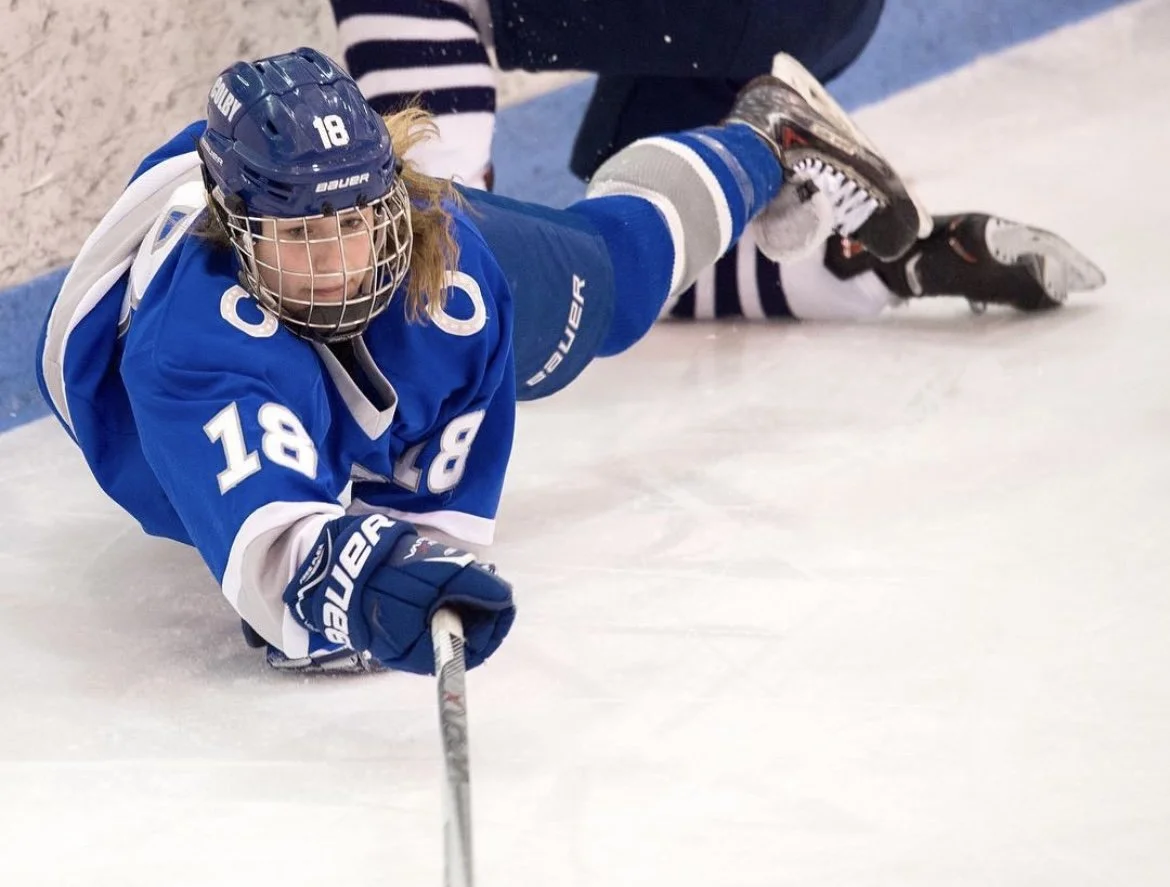
“Adult failure is hairy on another level and will probably always remain harder for me than falling ever was on the ice.
Bauer doesn’t make pads for embarrassment or helmets for disappointment, and there’s no referee blowing a whistle to pause real life after something goes wrong.”
One of the first things you learn when you start playing ice hockey is how to fall. I know it sounds totally ridiculous, given that most kids learning to skate spend more time falling than actually gliding. But there is a real difference between just falling and knowing how to fall safely, especially when you're hurtling toward a wall of hard plastic. The instruction was always the same, delivered by a patient dad-coach in a cold rink at seven in the morning: heads up, don't duck.
Your instincts tell you otherwise. When you lose an edge and feel yourself sliding into the boards, every self-preservation mechanism in your body screams at you to turn away, tuck your chin, curl up, and make yourself small before impact. In practice, however, this instinct is the most likely way to get hurt on the ice. Going into the boards with your head down is an E-Z Bake recipe for a spinal cord injury. The safer move is the one that feels the most frightening in the moment: keep your head up, face the boards, and trust the equipment built to absorb the blow.
So we practiced. Every fall, every game and practice, dangerously fast and hilariously slow, until eventually the fear drained out of it entirely. Before long, falling became just another part of playing hockey, no more challenging than a backwards crossover or a wrist shot. I knew how to take a hit. I knew how to go into the boards. I knew that if I lost an edge at full speed, I would slide, get up, and keep playing.
Looking back, I think this knowledge was the largest part of what made me a good hockey player. I was never the most graceful skater on the ice; my game was more bulldozer than ballerina. I went into corners hard, used my body, took risks I probably shouldn't have (in case you need proof, the cover photo for this piece was run in my hometown local newspaper at one point). I was never afraid of ending up on the ice, because I already knew exactly what happens next: you get back up.
There's a familiar story we tell about athletes once they've stopped playing. The discipline translates. The teamwork translates. The competitiveness translates. Employers like former athletes, the theory goes, because we arrive in adulthood already fluent in resilience. After nearly two decades of hockey, I assumed some version of this story would be true for me.
Instead, in a shocking turn of events, at age 22 I quit playing hockey entirely and suddenly became afraid to fall.
It took me years to understand the irony. On the ice, I'd been willing to take risks precisely because failure was familiar. I had practiced it thousands of times, until my body had a vocabulary for what to do when something went wrong, one so fluent I rarely had to think about it.
Adulthood, on the other hand, offered no equivalent instruction. Nobody sat me down at age 22 and explained what to do when I chose the wrong job, moved to the wrong city, fell in love with the wrong person, embarrassed myself, changed my mind, or tried something I wasn't immediately good at. There was no coach standing on the other side of the boards shouting instructions, no equipment engineered meticulously to absorb that particular impact. I knew how to fall at full speed on a sheet of ice but had absolutely no idea how to fail at anything that actually mattered.
So for most of my twenties, I became impressively skilled at avoiding situations where I might have to find out. I made thoughtful, responsible decisions. Decisions I could explain and defend, ones that accounted for downside scenarios and contingency plans and every conceivable way things might not work out. From the outside, this probably looked like competence, and much of the time it was. But underneath it sat a pool of fear, silent but constant.
The easiest way not to fail, after all, is to become extremely selective about what you're willing to try. And it works, to a point: I never accumulated a dramatic collection of adult failures. What I accumulated instead was an impressive amount of anxiety. Every meaningful risk demanded far more thinking, worrying, and emotional scaffolding than the decision itself probably warranted. I wanted some assurance that if I launched myself at something and missed, I would already know how the landing worked. Life, annoyingly, refuses to provide that.
It took turning my life completely upside down in my late twenties to understand how limiting this bargain had become. I made a series of decisions that felt enormous at the time, reshaping parts of my life I had treated as fixed and walking away from futures I'd spent years carefully constructing. There were absolutely no guarantees that what I was moving toward would be better than what I was leaving. It was one of the first times in my adult life I vividly remember thinking: this could actually not work. That possibility terrified me. And then I did it anyway.
I would love to say the experience permanently rewired something in me: that everything worked out beautifully, that I discovered the hidden value of risk, and emerged on the other side as one of those enviably unbothered people who shrug and ask, "What's the worst that could happen?" That is not what happened. I still hate failing. I still possess an extraordinary capacity to imagine every possible consequence of a decision before I've made it; given the chance, I can turn uncertainty into a full-time research project.
Instead, what's changed is much subtler. I've started to notice that some of the best decisions I've ever made were impossible to fully justify in advance. They required moving before I knew how things would turn out.
This has made me reconsider what I used to think courage looked like. I believed, as a kid, that I was fearless on the ice. I don't think that's quite true anymore. I think I had simply practiced the consequences of being fearless until they no longer frightened me, which is a very different thing, and a distinction that feels increasingly important the older I get.
We talk about risk as though the goal is to feel less afraid of it. Be bold. Take the leap. Bet on yourself. This kind of advice has always made me suspicious because it conveniently ignores the fact that sometimes the leap goes badly. Sometimes you take the risk and you're wrong. Sometimes you put yourself out there and get rejected. Sometimes you leave something perfectly fine in search of something better, only to discover that better is much harder to find than you expected. The possibility of failure isn't an unfortunate technicality attached to risk; it's the thing that makes it a risk in the first place.
What I wish we talked about more is how to become less afraid of the fall itself, and I had this backwards for years. I imagined that confidence came first: that eventually I would grow certain enough about myself, or my choices, or the direction of my life, that a large risk would simply stop feeling dangerous, and only then would I be ready to take it.
This was never how it worked in hockey, though. No coach ever convinced a rink full of six-year-olds that crashing into the boards wasn't scary. Instead, they taught us what to do when it happened anyway. They offered something far more useful than reassurance: instructions.
Keep your head up. Don't duck. Face the thing you're moving toward. Trust that you already know how to protect yourself. And, eventually, get back on your skates.
The strangest part is that my body's instinct when falling hasn't changed at all, even decades later. When something goes wrong, I want to contract, to protect myself, to retreat toward whatever feels safest, to make myself as small as possible until the danger or the hurt or the discomfort passes. And the instinct makes sense, it just isn't always useful because sometimes the impact is already coming. The decision has been made. The rejection has arrived. The plan hasn't worked. Curling inward at that point doesn't undo any of it. As an adult, you still have to move through it, whether you're braced for it or not.
I'm still learning how to do this with a brave face. Adult failure is hairy on another level and will probably always remain harder for me than falling ever was on the ice. Bauer doesn’t make pads for embarrassment or helmets for disappointment, and there’s no referee blowing a whistle to pause real life after something goes wrong.
But the bright spot is that I'm beginning to think the underlying skill behind falling isn't as different as it once seemed. Maybe the goal was never to become someone unafraid of falling. I'm not sure that person exists, and I'm not sure I'd want to be her if she did. Fear is useful, after all; it tells you when something matters.
Instead, the better skill - the one worth practicing - might be learning that fear doesn't require retreat. You can be scared out of your mind and still keep your head up. You can make a choice without knowing how it ends because you trust yourself to handle the ending, whatever it turns out to be.
I learned how to do this physically long before I was old enough to understand what I was actually learning, somewhere in a cold rink, wearing a helmet and my brother’s hand-me-down pads, practicing the strange art of overriding my own instinct to protect myself in the way that felt most obvious. I learned that sometimes the position that feels most exposed is the one that keeps you safest.
I'm still practicing the adult version.
Heads up. Don't duck.
