the Middle Child Survival guide
birth order, identity, and what it actually means to Grow up in the middle .
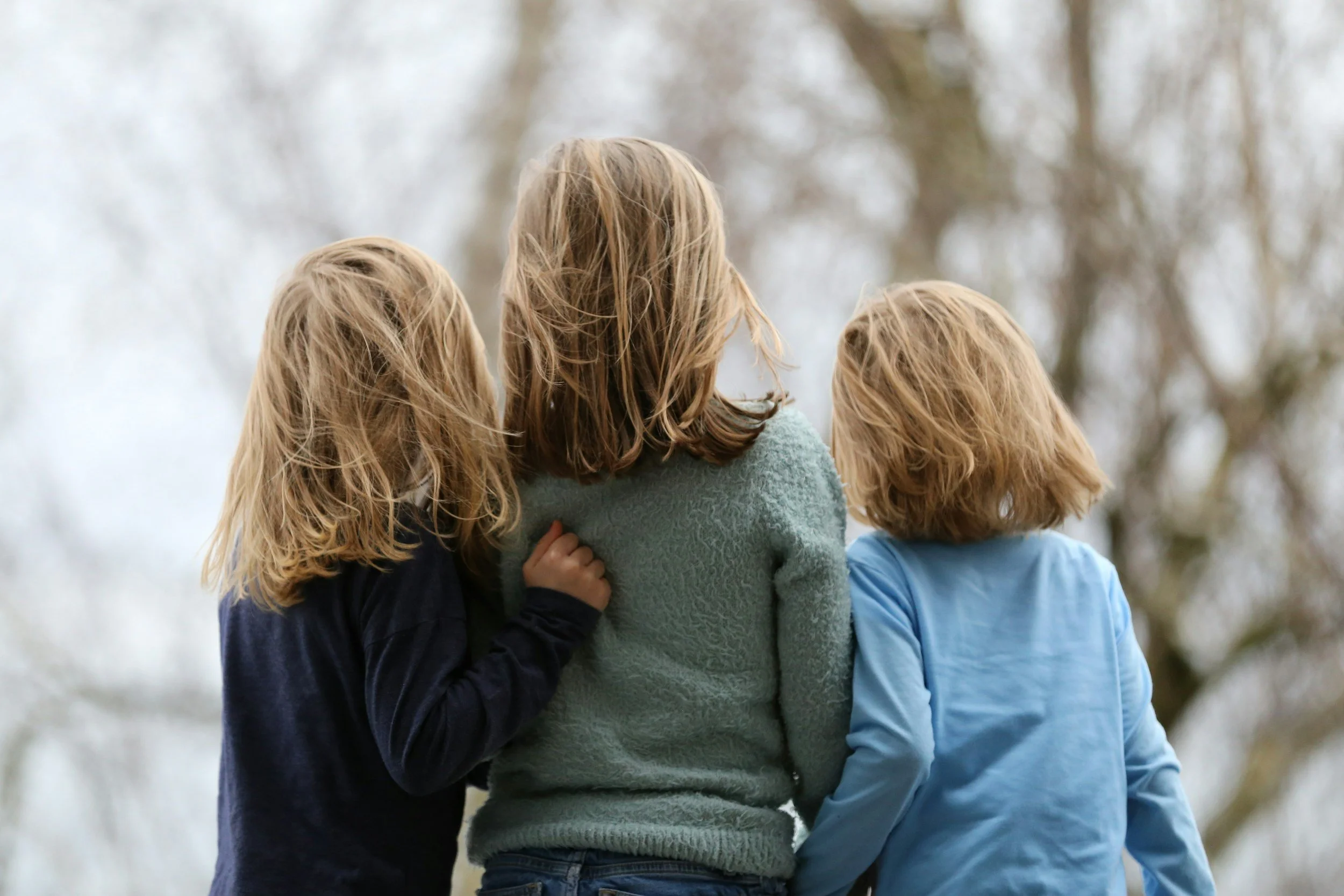
“People have always described me as adaptable, and I've taken it as a compliment.
But if you spend enough years learning to speak everyone else's language, it's only natural to wonder which one was yours to begin with.”
I think the easiest way to understand my family is to ask each of us what it was like to grow up in it. You'll get three completely different childhoods.
My younger sister would tell you that being the youngest is wildly overrated. She has one story in particular she's been shopping around for years: after one of our hockey games at a sports complex in Marlborough, MA (iykyk), my parents drove nearly an hour home before realizing she'd never gotten in the car. One of my brother's teammates' parents eventually brought her back, and she lived to tell the tale, but to her, it's Exhibit A in the case against being the baby of the family. My older brother would make an equally convincing argument for the oldest. He'd talk about responsibility and expectations, about being the one everyone looked to first, the one with the strictest rules in high school, even though he broke every single one of them.
Then there's me, the middle child. My mom was one too, and we've always huddled in the same camp whenever these conversations come up. Neither of us thinks we had it hardest. We're just fascinated by how convinced everyone else is that they did.
Three Different Childhoods
Birth order has always struck me as one of those subjects that lives somewhere between psychology and astrology. The stereotypes are broad enough that almost anyone can recognize themselves in them, which makes them easy to dismiss. But the older I've gotten, the more I've suspected there's something poignantly true hiding underneath them. Three kids can be raised by the same parents, in the same house, with the same rules and holidays, and somehow walk away believing they grew up in entirely different families. Children don't simply absorb what happens around them. They absorb the position from which they experience it, and those positions are surprisingly different.
I think that's especially true of middle children, though not for the reason people usually assume. The popular caricature is that we're overlooked, forgotten somewhere between the overachieving oldest and the adored youngest. I've never found that satisfying. My sister's abandoned-at-the-rink story is funny precisely because it happened exactly once. My parents weren't careless. They were raising three kids close in age who all seemed to require being in different places at once.
What I've come to believe instead is that the defining feature of being a middle child isn't a lack of attention. It's a lack of definition.
If you removed me from our family, my brother and sister would've been separated by nearly four years. Instead, because I existed between them, my parents had three kids growing up almost in lockstep. My brother was just eighteen months older than me, my sister two years younger. I was close enough in age to both that I spent my childhood looking in two directions at once: up at my brother, who always seemed older and more capable, and down at my sister, who always seemed smaller and in need of looking after.
It's such a simple thing, but it changes the entire family dynamic completely. My brother and sister rarely competed because their roles were already defined before either of them had done anything to earn them. He was unmistakably the oldest. She was unmistakably the youngest. Mine never felt quite so obvious. You don't inherit an identity as the middle child; you have to build one.
That ambiguity is hard to appreciate when you're a kid because you don't know any different. It just feels like life. Only later do you realize you spent your childhood practicing two roles at once.
Learning Everyone Else’s Language
My brother is one of the most left-brained people I've ever known. He loves mechanics and figuring out how things work, and at one point had an actual workshop in our basement, power tools and half-finished inventions scattered everywhere. If something broke at home, he wanted to fully dismantle it out of pure curiosity before fixing it. My sister is almost his opposite. Endlessly creative, she grew up painting and drawing and inventing elaborate imaginary worlds that felt completely real to her. Where my brother wanted to understand the world, she seemed perfectly happy creating another one.
For years I would've told you I landed somewhere between them because that's simply where my interests happened to fall. Now I'm not so sure. I think growing up between two people like that teaches you to speak both languages. I'm relentlessly analytical, and my greatest moments of satisfaction are when complicated situations suddenly start making sense. At the same time, my spreadsheets are color coded. My presentations take twice as long because I want them to be beautiful. For a long time I thought this combination was an unusual quirk. Now I think it was inevitable.
The same pattern showed up in my relationships with my parents. Hockey was the language my dad and I shared. So much of my childhood revolved around rinks, tournaments, and long car rides. I loved the sport, but I also loved what it represented: something that belonged to just the two of us, a place where effort translated into praise in a language we both understood.
With my mom, it was completely different. Ours was the language of beautiful homes, cooking, music, and hosting, the tiny aesthetic decisions that make a life feel curated. To this day, we have an absurd habit of showing up somewhere dressed in exactly the same outfit without planning it. Not just similar outfits, but the same sweater, the same shoes, the same jewelry, often enough that there are photographs to prove it.
For a long time I chalked this up to simply having a lot in common with the people around me. Lately, though, I've started wondering if something more intentional was happening.
The Reflex
Kids are unbelievably good at figuring out what earns connection. Nobody has to teach them. They notice what makes one parent light up, what wins approval from an older sibling, what comforts a younger one. I don't think I consciously decided to love hockey because it brought me closer to my dad, or that I became interested in design because it gave my mom and me endless things to talk about. I think I simply learned, without realizing it, to speak the languages of the people I loved. At first that feels like a family skill. Eventually, it becomes the way you move through the world.
This instinct has followed me into adulthood, though I didn't have language for it until recently. I've always been comfortable moving between people who seem to have little in common, sitting with a finance director one hour and the creative team the next, without feeling like I need different versions of myself for each. People have always described me as adaptable, and I've taken it as a compliment. But if you spend enough years learning to speak everyone else's language, it's only natural to wonder which one was yours to begin with.
I think that question sits underneath a lot of what people dismiss as middle child syndrome. The stereotype is that we become people pleasers, and there's probably some truth to it, but the label has always felt too easy. People pleasing suggests insecurity or conflict avoidance. What I'm describing feels more like pattern recognition. Mirroring isn't pretending; rather, it's less about becoming someone else than learning how to connect with them. When you grow up in the middle, you're constantly moving between perspectives, the younger sibling in one room and the older one in the next, and after enough years of switching, understanding other people becomes less a conscious effort than a reflex.
I can see that reflex all over my childhood. Around my brother, I was unmistakably the little sister, rolling my eyes at whatever invention had taken over the basement that week and finding his hobbies impossibly boring. Around my sister, I slipped naturally into the role of the oldest. If we played school, I was the teacher. If we played house, I somehow ended up in charge. Once, convinced I was qualified to run a spa, I plucked her eyebrows into two criminally thin lines she claims are permanent and has still not forgiven me for.
(Ironically, my brother once gave me a hack job of a haircut when we were toddlers, so maybe this was simply the family passing wretched beauty decisions down the birth order, one jacked up bowl cut rolling into one jacked up pair of eyebrows.)
Those memories are funny because they're ordinary, but they reveal something about the middle position. The oldest only ever learns what it's like to be the oldest. The youngest only ever learns what it's like to be the youngest. The middle child practices both jobs every day, until the switching becomes automatic.
There's another part of it I've rarely heard anyone talk about. The oldest gets to be an only child before anyone else arrives, and even after losing that position, they're immediately handed another: they'll always be the oldest. The youngest stays the youngest forever. The middle child is the only one who briefly gets to be the baby without getting to keep the job. Apparently, a few months after my sister was born, I asked my parents if they could take her back to the hospital. I have no memory of this, but they've told the story enough times that it's become family folklore. Somewhere between bringing home a new baby and settling into life as a family of five, I realized the attention that had securely belonged to me now belonged to someone else, and I apparently decided this arrangement was negotiable. I wasn't asking for a different sister. I just wanted my old role back.
Maybe that's why I don't think middle children are really fighting for attention. I think we're searching for definition. Attention comes and goes. Identity stays with you.
A Place Of Its Own
I don't think I was ever trying to become my brother or my sister or my mom or my dad. I was trying to figure out what belonged only to me, which is probably why so many middle children get so good at reading people. When there isn't an obvious role waiting for you, you start paying closer attention to everyone else's, learning when to step forward and when to disappear.
There are downsides for sure. Every strength has a shadow. I think middle children have a tendency toward people pleasing, or at least toward caring too much about harmony. If you've spent your childhood moving between different personalities and expectations, it's easy to lose track of where your own preferences begin. The ability to adapt can become a habit of over-adapting.
For years I thought all of this existed because I hadn't quite figured out who I was yet, that everyone else had clearer edges than I did. Now I wonder if the opposite is true. Maybe identity isn't something you're born with. Maybe it's something you assemble over time, borrowing pieces from the people who raise and challenge and love you until, eventually, the collection starts to look unmistakably like yourself. I see my dad in the parts of me that love competition and discipline, my mom in my love of beautiful places, my brother's curiosity and my sister's creativity in places I never would've expected. None of that makes me any less myself. If anything, it's the very thing that does.
My mom and I still smile whenever birth order comes up. Someone will make the case that the oldest had it hardest or the youngest got overlooked, and we'll exchange the same silent understanding we’ve shared for years. It's less agreement than recognition. Every position in a family comes with its own gifts and blind spots. I don't actually think middle children have it harder, I just think we're the only ones who grow up in a position that asks us to become a little bit of everyone before we figure out how to become ourselves.
And maybe that's why I've stopped thinking of the middle as the space between two people. Maybe it was a place of its own all along.
